Hello all,
I know I haven't written much up on here recently, despite my intentions to. But here's a little update. After life got in the way a touch, I have written two first drafts for short stories. One, a warning against using a cursed ancient tarot deck that one would sacrifice one's whole life to obtain; and the second, a pulp fiction style, World War Two set story about a commando that gets kidnapped for sport by a group of werewolf led brigands in the English countryside. Both will soon go through the editing stage and will be sent off to magazines with an eye towards them being published.
With that in mind, I have started writing the novel mentioned last post inspired by my love of Celtic myths and the stories of both MR James and Arthur Machen. It's taken quite a bit to research it and there'll be much more work needed on that front, but I'm sure it'll be a wondrous journey through an English county straddling the borders between our material world and the Netherworld, filled with many an eccentric character.
But, there is another novel in the pipeline as well. This will be a rip roaring sci-fi adventure storming across a frozen industrial planet, eager to repel its deformed alien clone invaders.
I have even in talks with a heavy metal band called Malleus to produce a short story or two to accompany their up and coming new album.
I am also in talks about doing some editing work for an RPG game as well.
All in all, I'll stay in touch.
This is the official blog for Thadeus Morticaine. He is an aspiring author of several genres, currently working on a action packed series of stories set during the English Civil War. There is also a gothic horror series based on someone that might just so happen to be his great-great-great-grandfather. Also in the pipeline are a fantasy series where magicians plumb the depths of the light spectrum to cast their spells, a World War Two period re-telling of folk tales and fairy stories, as well as a fast paced sci-fi series harking back to the old space operas. Oh, and don't forget a detective series where a maniacal villain awaits behind every corner.
With an indepth interest in history, old pulps and black and white movies, this blog will have regular posts about historical events that he finds inspiring and which he hopes will be of a great use to others with their stories, or to those with even the slightest of interests. There'll also be articles on authors and stories that he finds particularly interesting and inspirational. He hopes that you'll find them useful as well.
You can also follow him on facebook at Thadeus Morticaine
With an indepth interest in history, old pulps and black and white movies, this blog will have regular posts about historical events that he finds inspiring and which he hopes will be of a great use to others with their stories, or to those with even the slightest of interests. There'll also be articles on authors and stories that he finds particularly interesting and inspirational. He hopes that you'll find them useful as well.
You can also follow him on facebook at Thadeus Morticaine
His twitter account is @morticaine
He can also email him with this canny link Thadeus Morticaine
Showing posts with label folk tale. Show all posts
Wednesday, 28 March 2018
Tuesday, 23 June 2015
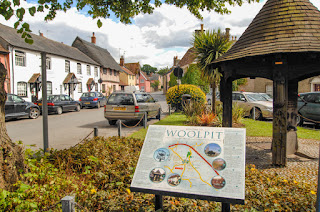
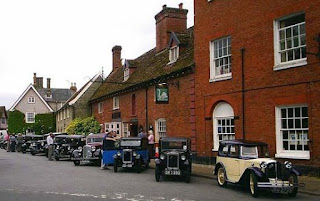
Of the Green Children
Again, this is segment from the
History of English Affairs by William Newburgh. It tells of two children who
turn up in an East Anglian village with green skin and who can’t speak a word
of English. I have read an account of this occurrence in the venerable Fortean
Times and I’ve been given the idea that this has gone down into local folklore
and the facts of which have been modified into a local fairy tale.
Enjoy!
![]() |
| Woolpit, Suffolk |
![]() |
| Green Children of Woolpit, Suffolk |
![]() |
| Woolpit, Suffolk |
![]() |
| Woolpit,,Suffolk |
Nor does it seem right to
pass over an unheard-of prodigy, which, as is well known, took place in England
during the reign of King Stephen. Though it is asserted by many, yet I have
long been in doubt concerning the matter, and deemed it ridiculous to give
credit to a circumstance supported on no rational foundation, or at least one
of a very mysterious character; yet, at length I was so overwhelmed by the
weight of so many and such competent witnesses, that I have been compelled to
believe, and wonder over a matter, which I was unable to comprehend, or
unravel, by any powers of intellect.
In East Anglia there is a
village, distant, as it is said, four or five miles from the noble monastery of
the blessed king and martyr, Edmund; near this place are seen some very ancient
cavities, called "Wolfpittes," that is, in English, "Pits for
wolves," and which give their name to the adjacent village. During
harvest, while the reapers were employed in gathering in the produce of the
fields, two children, a boy and a girl, completely green in their persons, and
clad in garments of a strange colour, and unknown materials, emerged from these
excavations. While wandering through the fields in astonishment, they were
seized by the reapers, and conducted to the village, and many persons coming to
see so novel a sight, they were kept some days without food. But, when they
were nearly exhausted with hunger, and yet could relish no species of support
which was offered to them, it happened, that some beans were brought in from
the field, which they immediately seized with avidity, and examined the stalk
for the pulse, but not finding it in the hollow of the stalk, they wept
bitterly. Upon this, one of the bystanders, taking the beans from the pods,
offered them to the children, who seized them directly, and ate them with
pleasure. By this food they were supported for many months, until they learnt
the use of bread.
At length, by degrees, they
changed their original colour, through the natural effect of our food, and
became like ourselves, and also learnt our language. It seemed fitting to
certain, discreet persons that they should receive the sacrament of baptism,
which was administered accordingly. The boy, who appeared to be the younger,
surviving his baptism but a little time, died prematurely; his sister, however,
continued in good health, and differed not in the least from the women of our
own country. Afterwards, as it is reported, she was married at Lynne, and was
living a few years since, at least, so they say.
Moreover, after they had
acquired our language, on being asked who and whence they were, they are said
to have replied, "We are inhabitants of the land of St. Martin, who is
regarded with peculiar veneration in the country which gave us birth."
Being further asked where that land was, and how they came thence hither, they
answered, "We are ignorant of both those circumstances; we only remember
this, that on a certain day, when we were feeding our father's flocks in the
fields, we heard a great sound, such as we are now accustomed to hear at St.
Edmund's, when the bells are chiming; and whilst listening to the sound in
admiration, we became on a sudden, as it were, entranced, and found ourselves
among you in the fields where you were reaping." Being questioned whether
in that land they believed in Christ, or whether the sun arose, they replied
that the country was Christian, and possessed churches; but said they,
"The sun does not rise upon our countrymen; our land is little cheered by
its beams; we are contented with that twilight, which, among you, precedes the
sun-rise, or follows the sunset. Moreover, a certain luminous country is seen,
not far distant from ours, and divided from it by a very considerable
river." These, and many other matters, too numerous to particularize, they
are said to have recounted to curious inquirers. Let everyone say as he
pleases, and reason on such matters according to his abilities; I feel no
regret at having recorded an event so prodigious and miraculous.
Appendix 1: On further research, I have found that there is a form of lead
poisoning that comes about when a person lives without proper access to
daylight. This can give a person grey
skin tinged with a little green. This is the nearest thing I have found to a
none supernatural explanation to this phenomena. As for the children not being
able to understand a word of English, it could be speculated that they could
have been Welsh or Cornish. The Celtic language would still have been common in
Wales or Cornwall in the 12th century. Could that have been the case
with these two youngsters? With small parties of Vikings making their way to
the Arabian court and to America during the previous four centuries, it could
be possible. Stranger things have happened.
![]() |
| Welsh tin mine |
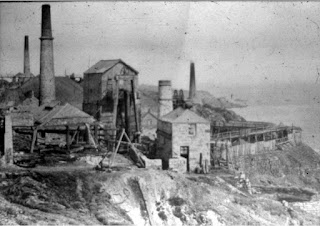
Appendix 2: In regards to the two youngsters appearing out of the ground, there
could very well be a connection with this and the possibility that they were
from mining families – see above, in relation to the possible lead
poisoning/sunlight deprivation. Mines would have employed children in this
period. Living in or near mines and caverns may well have been the only thing
that they were used to. Thus, they would have sought shelter in similar places
on their possible journey east.
Labels:
12th century,
fairy tale,
folk tale,
folklore,
Green Children,
History of English Affairs,
occult,
paranormal,
Suffolk,
supernatural,
tin mine,
Viking,
Wales,
Welsh,
William of Newburgh,
Woolpit
Wednesday, 10 June 2015
Salutations
All!
He’s a little
piece of my researches that I hope you find interesting. It’s a piece taken
from a book called Bradwell: Ancient and Modern that was published in 1912 –
Bradwell is a village in Derbyshire. A man called Seth Evans wrote about a
beast called a Lumb Boggart.
![]() |
| Bradwell, Derbyshire |
![]() |
| Old Bradwell, Derbyshire |
In the book,
Evans entitles this piece ‘an absurd tale which everybody believed even down to
half a century ago. A Lumb, you might like to know is the old English word for
pool and a Boggart is traditionally a type of rogue hobgoblin that had left
their homes because their human co-inhabitants didn’t care for them properly,
but by the 1800s, a boggart referred to something different. Where previously a
boggart had been a shunned, rogue domestic goblin living in the wilds, living
off what it could steal from travellers, it became interchangeable with the
word ghost. Many tales from the late 1700s and most of the 1800s including
boggarts have a lot of similarities with what we know categorise as cases of
poltergeist activity.
![]() |
| Exorcism |
I did a little
research into what an ousel was. Just for peace of mind and ease of reading,
it’s a bird that nests in rocky crevices.
![]() |
| Ousel |
Anyway, here’s
the extract:
It used to be said that about a century and a half ago
(1710 ish) the body of a young girl who was supposed to have been murdered was
found buried under the staircase of a house at Hill Head. The ghost of the girl
appeared every night until everyone in the neighbourhood were terrified and
thrown into a cold sweat. Unable to bear it any longer the people got a
well-known individual who belonged to the Baptists… to undertake the task of
‘laying’ the ghost. As this individual professed to be able to rule the
planets. Of course, no one doubted his power of getting rid of the ghost.
The time came, and the haunted house was filled with
affrighted spectators when the exorcist appeared among them with his
paraphernalia, and when he prayed until streams of sweat poured from his face
as he knelt within a ring he had chalked on the chamber floor, the lookers-on
kneeling around, and later afterwards declared that they “felt the floor move
for yards up and down in quick succession.” Then the magician arose and
exclaimed, “Arise! Arise! I charge and command thee,” when the spirit appeared,
and the man ordered it to depart and assume the body of a fish, and to locate
itself in the Lumb Mouth. He also ordered that every Christmas Eve the ghost
should assume the form of a white ousel, and fly to Lumbly Pool.
Consequently,
the family that lived at Hill Head moved soon after this incident.
Labels:
Boggart,
Derby,
Derbyshire,
folk tale,
Ghost,
history,
horror,
paranormal,
supernatural,
writer,
Writing
Subscribe to:
Posts (Atom)